In Saudi Arabia’s rapidly industrializing economy, the forklift basics overview has become essential for business success. This comprehensive industrial forklift overview delivers insights into forklift safety principles, warehouse equipment basics, and scenarios that optimize your operations. Here is the understanding flatbed performance factors profoundly impacts operational efficiency and cost structure. These statistics underscore why businesses across Saudi Arabia are prioritizing strategic forklift rental decisions over capital-intensive purchases.

1. Forklift Types Explained: Matching Equipment to Application

Understanding Classification Systems

Before evaluating specific models, successful warehouse equipment basics comprehension begins with understanding the forklift classifications designed for specific operational scenarios. An industrial forklift overview requires distinguishing between power sources, design configurations, and environmental suitability.

By Power Source:

Electric Forklifts:

  • Power System: Rechargeable battery systems (lead-acid or lithium-ion)
  • Ideal Environment: Indoor applications with smooth, flat surfaces
  • Key Advantages: Zero emissions, quieter operation (ideal for noise-sensitive environments), lower long-term operating costs
  • Typical Capacity: 1.5 to 7 tons (suitable for most warehouse applications)
  • Saudi Market Position: Commanding 55.30% market share in 2024 and advancing at 12.18% CAGR through 2030

Diesel Forklifts:

  • Power System: Diesel internal combustion engine
  • Ideal Environment: Outdoor applications, heavy-duty operations, rough terrain
  • Key Advantages: Maximum power and torque, extended runtime, best for heavy lifting (up to 25+ tons)
  • Typical Capacity: 7 to 25+ tons (ideal for construction, oil & gas, ports)
  • Saudi Application: Preferred for industrial yards, construction sites, and outdoor logistics operations

LPG (Liquefied Petroleum Gas) Forklifts:

  • Power System: LPG combustion engine with replaceable gas cylinders
  • Ideal Environment: Indoor/outdoor versatility with adequate ventilation
  • Key Advantages: Quick refueling (minutes vs. hours for electric charging), consistent power throughout operation
  • Typical Capacity: 1.5 to 7 tons (versatile mid-range applications)
  • Saudi Context: Popular in mixed indoor/outdoor warehouses without battery charging infrastructure

OSHA Classification Standards

Class I – Electric Motor Rider Trucks:

  • Examples: 3-wheel and 4-wheel counterbalance riders
  • Applications: Indoor warehouses, distribution centers, retail operations
  • Characteristics: Compact, maneuverable, zero emissions

Class II – The Electric Motor Narrow Aisle Trucks:

  • Examples: Reach trucks, order pickers, articulated forklifts
  • Applications: High-density storage warehouses with narrow aisles
  • Characteristics: Specialized for vertical reach and confined spaces

Class III – Electric Motor Hand/Rider Trucks:

  • Examples: Pallet jacks, electric walkie stackers, material lifts
  • Applications: Light-duty material movement, ground-level pallet handling
  • Characteristics: Manual or electric-assist, ideal for low-capacity tasks

Class IV – Internal Combustion Engine Trucks (Solid/Cushion Tires):

  • Examples: LPG, gasoline, diesel forklifts with cushion tires
  • Applications: Indoor/outdoor use on smooth surfaces
  • Characteristics: Versatile, powerful, suitable for mixed environments

Class V – Internal Combustion Engine Trucks (Pneumatic Tires):

  • Examples: Diesel and LPG forklifts with pneumatic tires
  • Applications: Outdoor yards, construction sites, rough terrain
  • Characteristics: All-terrain capability, maximum stability on uneven surfaces

Ashwheelz maintains a comprehensive fleet spanning all major classifications, with Aramco-certified units ranging from 3 to 16 tons capacity, ensuring precise matching to your operational requirements across Saudi Arabia’s diverse industrial applications.
2. Forklift Capacity Basics: Understanding Load Limits and Ratings

Decoding Load Center and Weight Ratings

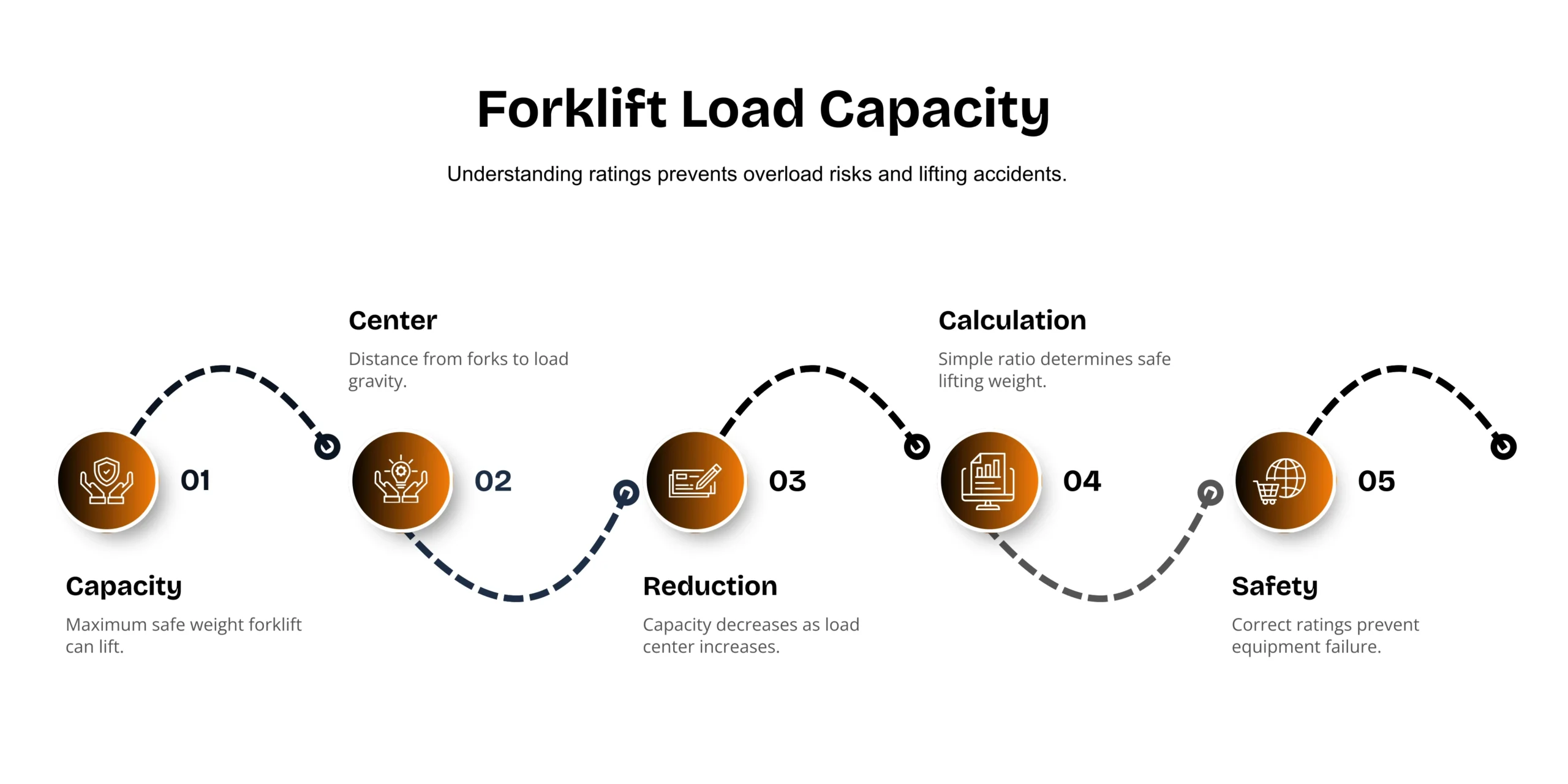
Forklift load limits represent one of the most critical yet frequently misunderstood aspects of material handling equipment. Forklift capacity basics require understanding the relationship between rated capacity, load center, and actual lifting capability.

Load Center Fundamentals:

The load center represents the horizontal distance from the fork’s vertical face to the cargo’s center of gravity. Standard forklifts are rated at a 24-inch (600mm) load center, meaning the specified capacity applies when the load’s center sits 24 inches from the fork face.

Critical Capacity Principle: Moving the load center further from the forklift reduces effective lifting capacity. A forklift rated for 5,000 lbs at a 24-inch load center might safely lift only 3,500 lbs when the load center extends to 36 inches.

Calculation Example:

Standard Rating: 5,000 lbs @ 24″ load center. Actual Load: Center of gravity at 36″ from forks. Capacity Reduction Formula: (24 ÷ 36) × 5,000 = 3,333 lbs maximum safe load

Forklift Rated Capacity

Load at 24″ Center

Load at 36″ Center

Load at 48″ Center

3,000 lbs (1.4 tons)

3,000 lbs

2,000 lbs

1,500 lbs

5,000 lbs (2.3 tons)

5,000 lbs

3,333 lbs

2,500 lbs

10,000 lbs (4.5 tons)

10,000 lbs

6,667 lbs

5,000 lbs

15,000 lbs (6.8 tons)

15,000 lbs

10,000 lbs

7,500 lbs

Forklift Stability Concepts: The Stability Triangle

Understanding forklift stability concepts prevents tip-overs—the leading cause of forklift accidents and equipment damage. Forklifts maintain stability through a “stability triangle” formed by the two front wheels and the pivot point of the rear axle.

Stability Principles:

  • Centered Load: Keeping the load’s center of gravity within the stability triangle ensures balance
  • Height Impact: Raising loads to higher elevations; elevates the center of gravity, reducing stability
  • Travel Direction: Traveling with loads elevated, especially on inclines, dramatically increases tip-over risk
  • Turning Dynamics: Sharp turns shift the center of gravity, potentially outside the stability triangle

Safe Operating Practices:

  • Transport loads with mast fully lowered (4-6 inches off ground)
  • Tilt the mast backward when carrying loads to improve stability
  • Slow down when turning, especially with heavy or tall loads
  • Travel backwards when loads obstruct forward visibility

Ashwheelz provides comprehensive operator training alongside every forklift rental, ensuring teams understand capacity calculations and stability principles. As they’re specific to Saudi Arabia’s demanding industrial environments.

3. Indoor vs Outdoor Forklifts: Environmental Suitability Factors

Matching Equipment to Operating Environment

Selecting between indoor vs outdoor forklifts represents a fundamental decision impacting safety, efficiency, and regulatory compliance. Operating trailer factors include surface conditions, ventilation, temperature ranges, and load characteristics.

Indoor Forklift Requirements:

Electric Forklifts – The Indoor Standard:

  • Zero Emissions: No exhaust fumes protect worker health and air quality
  • Noise Reduction: Quieter operation (65-75 dB) suitable for enclosed spaces
  • Surface Compatibility: Cushion tires are ideal for smooth concrete floors
  • Maneuverability: Compact wheelbase navigates narrow warehouse aisles
  • Saudi Applications: Distribution centers, cold storage facilities, food processing plants, pharmaceutical warehouses

Indoor Considerations:

  • Adequate battery charging infrastructure is required
  • Smooth, level floors maximize efficiency and battery life
  • Climate-controlled environments extend equipment lifespan
  • Limited dust exposure reduces maintenance requirements

Outdoor Forklift Requirements:

Diesel and LPG Forklifts – The Outdoor Powerhouses:

  • Power Delivery: Higher torque handles rough terrain and inclines
  • Weather Resistance: Designed for temperature extremes and dust exposure
  • Tire Configuration: Pneumatic tires absorb shocks on uneven surfaces
  • Extended Runtime: Diesel tanks enable 8-12 hour continuous operation
  • Saudi Applications: Construction sites, oil & gas yards, port operations, industrial outdoor logistics

Outdoor Considerations:

  • Proper ventilation for combustion engine emissions
  • Regular maintenance addressing sand and dust infiltration
  • Temperature management in 45°C+ summer conditions
  • Fuel availability and storage infrastructure

Multi-Environment Operations:

LPG forklifts offer versatility for businesses requiring both indoor and outdoor capability:

  • Can operate indoors with adequate ventilation (minimum 10,000 cubic feet per minute airflow)
  • Quick cylinder changes enable seamless indoor/outdoor transitions
  • Lower emissions than diesel (suitable for semi-enclosed spaces)
  • Maintains consistent power regardless of the environment

Ashwheelz logistics specialists conduct complimentary site assessments, evaluating your specific environmental conditions, and recommending optimal equipment configuration. This is essential to balance performance, safety, and cost-effectiveness.

4. Electric vs Diesel Forklifts: Comprehensive Comparison

Power Source Decision Framework

The electric vs diesel forklifts decision profoundly impacts operational costs, environmental compliance, maintenance requirements, and application suitability. These factors that take on heightened significance in Saudi Arabia’s evolving regulatory and economic landscape.

Electric Forklift Advantages:

Cost Efficiency:

  • Lower operating costs (electricity vs. diesel fuel)
  • Reduced maintenance expenses (no engine, transmission, radiator)
  • Longer equipment lifespan (fewer moving parts subject to wear)
  • Qualification for government sustainability incentives

Environmental & Safety Benefits:

  • Zero on-site emissions supporting Saudi Arabia’s 2060 net-zero target
  • Improved indoor air quality protects worker health
  • Significantly quieter operation, reducing workplace noise pollution
  • No fuel storage/handling reduces fire risk and regulatory compliance burden

Electric Forklift Limitations:

  • Higher initial purchase/rental cost (especially lithium-ion models)
  • Charging infrastructure required (dedicated space, electrical capacity)
  • Battery charging time (6-8 hours for lead-acid; 1-2 hours for lithium-ion)
  • Limited outdoor/rough terrain capability
  • Battery performance degradation in extreme temperatures

Diesel Forklift Advantages:

Power & Performance:

  • Maximum lifting capacity (7-25+ tons vs. electric’s 1.5-7 ton range)
  • Superior torque for inclines and heavy-duty applications
  • Extended continuous operation (8-12 hours per tank)
  • All-terrain capability with pneumatic tires
  • Faster refueling (minutes vs. hours for charging)

Operational Flexibility:

  • No dependence on electrical infrastructure
  • Consistent performance in extreme Saudi heat (45°C+)
  • Suitable for demanding outdoor construction and industrial sites
  • Lower initial equipment cost than electric equivalents

Diesel Forklift Limitations:

  • Higher fuel costs (volatile diesel pricing)
  • Increased emissions are subject to environmental regulations
  • Greater noise levels (85-95 dB vs. electric’s 65-75 dB)
  • More frequent maintenance (oil changes, filter replacements, engine servicing)
  • Indoor use restrictions due to exhaust fumes

Saudi Arabia Market Trends

Electric forklifts held 55.30% of Saudi Arabia’s forklift rental market share in 2024 and will advance at 12.18% CAGR through 2030, driven by:

  • Vision 2030’s sustainability mandates
  • Growth in climate-controlled warehousing for e-commerce
  • Stricter emissions regulations in urban industrial zones
  • Total cost of ownership advantages over multi-year rentals

However, diesel forklifts remain essential for:

  • Oil & gas operations in remote Eastern Province locations
  • Construction sites for NEOM, Red Sea, and Qiddiya mega-projects
  • Port operations in Dammam, Khobar, Jeddah, and Jubail
  • Heavy industrial manufacturing requiring maximum capacity

Ashwheelz offers both electric and diesel forklifts with transparent cost comparisons, helping businesses select equipment. These factors optimizes both immediate operational needs and long-term strategic goals.

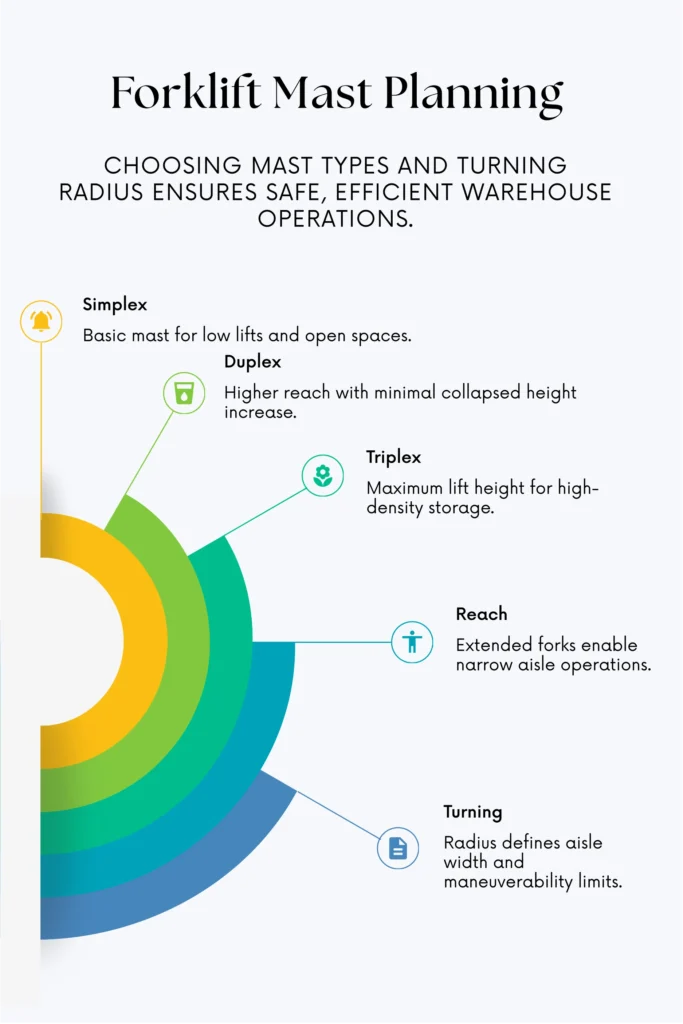
5. Forklift Mast Types and Turning Radius Considerations

Power Source Decision Framework

The electric vs diesel forklifts decision profoundly impacts operational costs, environmental compliance, maintenance requirements, and application suitability. These factors that take on heightened significance in Saudi Arabia’s evolving regulatory and economic landscape.

Electric Forklift Advantages:

Cost Efficiency:

  • Lower operating costs (electricity vs. diesel fuel)
  • Reduced maintenance expenses (no engine, transmission, radiator)
  • Longer equipment lifespan (fewer moving parts subject to wear)
  • Qualification for government sustainability incentives

Environmental & Safety Benefits:

  • Zero on-site emissions supporting Saudi Arabia’s 2060 net-zero target
  • Improved indoor air quality protects worker health
  • Significantly quieter operation, reducing workplace noise pollution
  • No fuel storage/handling reduces fire risk and regulatory compliance burden

Electric Forklift Limitations:

  • Higher initial purchase/rental cost (especially lithium-ion models)
  • Charging infrastructure required (dedicated space, electrical capacity)
  • Battery charging time (6-8 hours for lead-acid; 1-2 hours for lithium-ion)
  • Limited outdoor/rough terrain capability
  • Battery performance degradation in extreme temperatures

Diesel Forklift Advantages:

Power & Performance:

  • Maximum lifting capacity (7-25+ tons vs. electric’s 1.5-7 ton range)
  • Superior torque for inclines and heavy-duty applications
  • Extended continuous operation (8-12 hours per tank)
  • All-terrain capability with pneumatic tires
  • Faster refueling (minutes vs. hours for charging)

Operational Flexibility:

  • No dependence on electrical infrastructure
  • Consistent performance in extreme Saudi heat (45°C+)
  • Suitable for demanding outdoor construction and industrial sites
  • Lower initial equipment cost than electric equivalents

Diesel Forklift Limitations:

  • Higher fuel costs (volatile diesel pricing)
  • Increased emissions are subject to environmental regulations
  • Greater noise levels (85-95 dB vs. electric’s 65-75 dB)
  • More frequent maintenance (oil changes, filter replacements, engine servicing)
  • Indoor use restrictions due to exhaust fumes


Saudi Arabia Market Trends

Electric forklifts held 55.30% of Saudi Arabia’s forklift rental market share in 2024 and will advance at 12.18% CAGR through 2030, driven by:

  • Vision 2030’s sustainability mandates
  • Growth in climate-controlled warehousing for e-commerce
  • Stricter emissions regulations in urban industrial zones
  • Total cost of ownership advantages over multi-year rentals

However, diesel forklifts remain essential for:

  • Oil & gas operations in remote Eastern Province locations
  • Construction sites for NEOM, Red Sea, and Qiddiya mega-projects
  • Port operations in Dammam, Khobar, Jeddah, and Jubail
  • Heavy industrial manufacturing requiring maximum capacity

Ashwheelz offers both electric and diesel forklifts with transparent cost comparisons, helping businesses select equipment. These factors optimizes both immediate operational needs and long-term strategic goals.

6. Warehouse Layout Planning and Material Handling Safety

Facility Optimization for Forklift Operations

Effective warehouse layout planning integrates forklift specifications with storage density, workflow efficiency, and industrial equipment guidelines. Material handling safety depends on thoughtful facility design, preventing accidents before they occur.

Aisle Configuration Planning:

Wide Aisle Layouts (3.5-4.0m):

  • Compatible with all forklift types
  • Higher safety margins reduce collision risk
  • Lower storage density (fewer pallet positions per square meter)
  • Ideal for high-volume, fast-turnover operations

Narrow Aisle Layouts (2.7-3.3m):

  • Requires specialized forklifts (3-wheel or reach trucks)
  • 25-40% increased storage density
  • Slower operations requiring precise maneuvering
  • Best for high-value, slower-moving inventory

Very Narrow Aisle (VNA) Layouts (1.8-2.5m):

  • Demands Class II equipment (reach trucks, order pickers)
  • Maximum storage density (50-70% increase vs. wide aisles)
  • Requires guidance systems (wire or rail)
  • Ideal for high-SKU-count, space-constrained facilities

Safety Zone Implementation:

Loading Dock Areas:

  • Designated forklift-only zones with clear markings
  • Wheel chocks and dock locks are preventing trailer movement
  • Adequate lighting (minimum 50 lux) for visibility
  • Clear communication protocols between forklift operators and truck drivers

Pedestrian Protection:

  • Physical barriers separating forklift lanes from walkways
  • Clearly marked pedestrian crossings with signage
  • Elevated walkways in high-traffic areas
  • Prohibition of pedestrians in active forklift zones

Storage Area Safety:

  • Racking inspections identifying damage requiring repair
  • Load capacity placards on all racking systems
  • Clear overhead clearance (minimum 20cm above the highest load)
  • Sprinkler system compatibility with storage heights

Saudi Arabia Specific Considerations:

  • Temperature management in non-climate-controlled warehouses (electric battery performance)
  • Dust control systems protecting equipment and visibility
  • Prayer break scheduling and coordinating forklift operations
  • Cultural sensitivity in mixed-gender work environments

Why Ashwheelz Excels Across All Criteria:

Comprehensive Fleet: 3-16 ton capacity range spanning all power sources

Aramco Certification: Qualified equipment for oil & gas applications

Operator Services: Certified, experienced operators available

24/7 Support: Emergency response throughout Eastern Province and nationwide

Transparent Pricing: No hidden fees, clear maintenance responsibility division

Proven Reliability: 99%+ uptime through rigorous maintenance protocols

7. Transform Your Operations: Partner with Ashwheelz Today

You’ve absorbed a comprehensive forklift basics overview knowledge, from forklift types explained to forklift capacity basics, from forklift operation fundamentals to forklift safety principles. This expertise positions you to make informed material handling equipment decisions that optimize efficiency, protect your team, and control costs.

But knowledge transforms into operational excellence only through strategic action.

Three Pathways to Ashwheelz Partnership

Option 1: Complimentary Equipment Assessment. Our material handling specialists conduct detailed site evaluations, including:

  • Load profile analysis and capacity matching
  • Facility layout review and aisle width verification
  • Power source recommendations based on your environment
  • Total cost of operation projections

Request Your Free Assessment: Contact Ashwheelz

Option 2: Immediate Forklift Quote (Same-Day Response)

  • Detailed equipment specifications and availability
  • Transparent rental rates with no hidden fees
  • Operator service options if needed
  • Delivery timeline confirmation

Get Your Quote Now: Forklift Rental Services

Option 3: Emergency Equipment Deployment

  • Urgent forklift requirements within 2-6 hours
  • 24/7 availability throughout Saudi Arabia
  • Certified operators for immediate mobilization


Final Thoughts: Strategic Material Handling Investment

When evaluating forklift rental decisions, remember that proper equipment selection represents a strategic investment. Factors like operational efficiency, worker safety, regulatory compliance, and competitive positioning better. It’s not mere material handling expense.

Every productivity loss carries opportunity cost. Every safety incident damages reputation and morale. Every equipment decision impacts your bottom line.

The solution? Partner with Saudi Arabia’s most trusted forklift rental provider, a company combining comprehensive equipment inventory, regulatory expertise, operator availability, and unwavering commitment to client success.

Ashwheelz stands ready to transform your material handling challenges into operational advantages.

Your operations deserve reliability. Your team deserves safety. Your budget deserves transparency.

Ashwheelz delivers all three, every rental, every project, every time.