
In Saudi Arabia’s rapidly expanding industrial landscape, the power rental market is projected to surge. Mastering industrial generator selection has become a critical success factor for project managers and operations directors. Whether you’re orchestrating mega-infrastructure projects under Vision 2030 or managing remote oil and gas operations. Moreover, establishing manufacturing facilities in Jubail Industrial City, leveraging reliable energy rental solutions directly impacts project timelines, operational continuity, and profitability.
Understanding industrial power requirements goes beyond simply matching kilowatts to consumption. It demands strategic temporary power planning that accounts for Saudi Arabia’s environmental challenges, stringent safety standards, and ambitious construction schedules. This guide delivers actionable insights into project power assessment, empowering you to make confident decisions. Following is how our operational power efficiency solutions protect your operations and maximize ROI
Successful project power assessment begins with a comprehensive analysis of your electrical ecosystem. Industrial energy planning requires evaluating both obvious and hidden power consumers that collectively determine your facility’s total energy appetite.
Critical Assessment Questions:
Saudi Arabia’s extreme climate places extraordinary demands on cooling systems, with HVAC equipment consuming 40-60% of total power. Summer temperatures exceeding 45°C mean your generator must reliably support intensive cooling loads.
Step 1: Total Running Wattage – List every electrical device and sum simultaneous running loads
Step 2: Account for Starting Surge – Multiply the largest motor’s running wattage by starting coefficient (typically 3-6x)
Step 3: Safety Margin – Add 25-30% buffer for unforeseen loads and efficiency losses
Example Calculation:
Total Running Loads: 150 kW
Largest Motor Starting Surge: 45 kW × 5 = 225 kW
Subtotal: 150 kW + 225 kW = 375 kW
Safety Margin (25%): 375 kW × 1.25 = 469 kW
Recommended Generator: 500-550 kVA minimum
Ashwheelz provides complimentary power assessment services and deploys experienced engineers. They conduct on-site evaluations to ensure your generator sizing aligns perfectly with your operational reality.
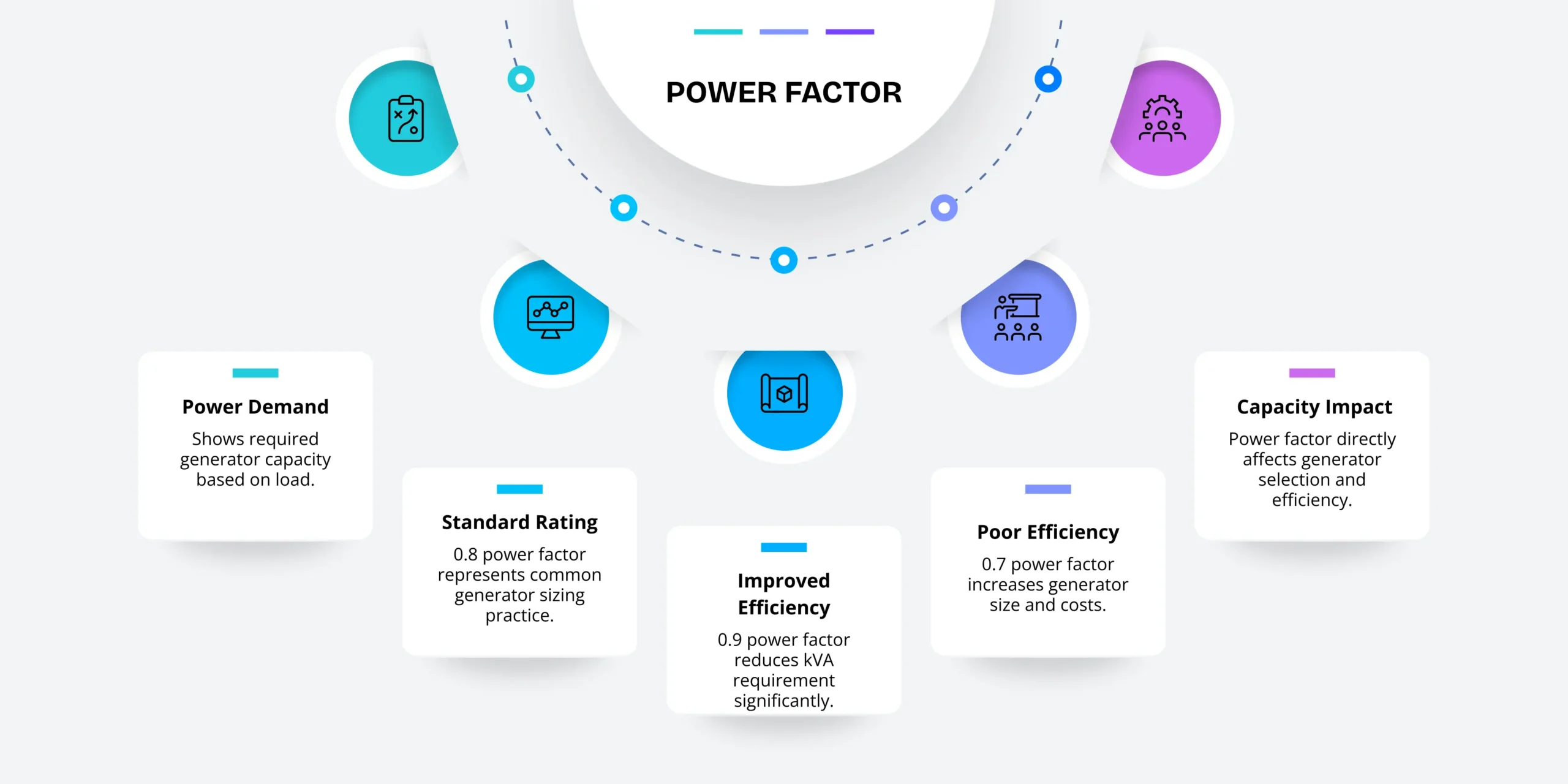
One of the most critical aspects of generator load calculation involves converting between kilowatts (kW) and kilovolt-amperes (kVA). These are the standard rating systems for generators.
The Essential Formula:
kVA = kW ÷ Power Factor
International Standard: Generators are rated at 0.8 power factor (80% efficiency)
If your power demand estimation reveals 400 kW total requirement:
Power Requirement (kW) | Standard Rating 0.8 PF (kVA) | Improved 0.9 PF (kVA) | Poor 0.7 PF (kVA) |
100 kW | 125 kVA | 111 kVA | 143 kVA |
250 kW | 313 kVA | 278 kVA | 357 kVA |
500 kW | 625 kVA | 556 kVA | 714 kVA |
1,000 kW | 1,250 kVA | 1,111 kVA | 1,429 kVA |
The standby vs prime generators distinction represents one of the most consequential decisions in industrial generator selection.
Standby (Emergency) Generators:
Key Characteristics:
Prime Power Generators:
Key Characteristics:
Vision 2030 initiatives have created unprecedented demand:
Standby Applications: NEOM development, Riyadh Metro, data centers, healthcare expansion
Prime Power Applications: Remote Empty Quarter drilling, Red Sea tourism construction, industrial parks during grid expansion
Ashwheelz maintains diverse generator fleets optimized for both standby and prime applications. With capacities ranging from 20 kVA portable units to 1,500+ kVA industrial powerhouses.
Fuel type considerations profoundly impact operational costs, environmental compliance, runtime capabilities, and maintenance requirements.
Diesel Generators: The Industrial Workhorse
Advantages:
Considerations:
Natural Gas Generators: The Clean Alternative
Advantages:
Considerations:
Understanding voltage and phase requirements prevents costly mismatches between generator output and equipment specifications.
Single-Phase Power (230V/240V):
Three-Phase Power (380V/400V):
Saudi Arabia’s industrial facilities universally operate on three-phase 380V/400V systems. Ashwheelz technical specialists verify voltage, phase configuration, and frequency requirements (50Hz standard) before deployment.
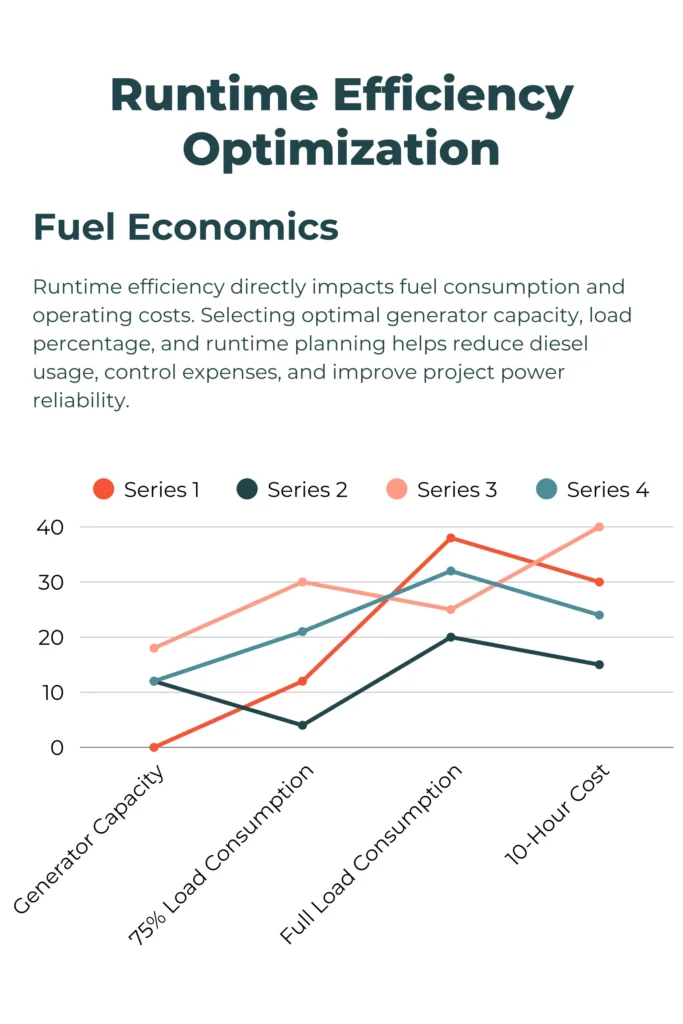
Runtime and efficiency factors directly determine your project’s energy costs, critical during extended power rental periods.
Approximate Fuel Consumption Rates (Diesel):
Generator Capacity | 75% Load Consumption | Full Load Consumption | 10-Hour Cost (SAR) |
100 kVA (80 kW) | 18-22 L/hour | 24-28 L/hour | 1,800-2,200 |
250 kVA (200 kW) | 45-52 L/hour | 58-65 L/hour | 4,500-5,200 |
500 kVA (400 kW) | 85-95 L/hour | 110-125 L/hour | 8,500-9,500 |
1,000 kVA (800 kW) | 165-185 L/hour | 215-240 L/hour | 16,500-18,500 |
Efficiency Optimization Strategies:
Noise level considerations have become increasingly stringent in Saudi Arabia, with regulatory authorities implementing strict limits on industrial noise emissions.
Generator Acoustic Categories:
Practical Mitigation Strategies:
Industrial safety standards compliance represents a non-negotiable requirement for generator deployment in Saudi Arabia.
Essential Certifications:
Aramco Certification – Gold standard demonstrating compliance with the Kingdom’s most rigorous safety specifications
ISO 8528 – International benchmarks for reciprocating engine-driven generating sets
SASO Standards – National technical regulations ensuring minimum safety criteria
Environmental Operating Conditions:
Ashwheelz Safety Commitment:
Sophisticated backup power planning encompasses redundancy design and generator scalability planning.
Parallel Generator Configuration Advantages:
Example Configuration:
Project requiring 2,000 kVA:
Option B provides 75% capacity if one fails, improved fuel efficiency at lighter loads, and modular expansion capability.
Pre-Deployment Assessment:
Infrastructure:
Electrical Integration:
Environmental & Regulatory:
Ashwheelz Turnkey Solutions:
The evidence is conclusive: proper industrial generator selection transforms power infrastructure from liability to competitive advantage. The Middle East GCC market is projected to reach USD 941.93 million by 2031, and forward-thinking executives are securing reliable power partnerships now.
Don’t let power uncertainty compromise your project success.
Location:
Immediate Assistance:
Generator Services: Ashwheelz Energy Solutions
Free Assessment: Request Power Consultation
You now possess a comprehensive understanding of industrial generator selection. From power demand estimation to fuel type considerations. From standby vs prime generators to backup power planning strategies.
But knowledge without action is just information.
Every day without proper temporary power planning creates cascading problems: construction delays, equipment idle time, emergency rentals at premium rates, and safety incidents from improperly sized equipment.
Option 1: Complimentary Power Assessment – Zero obligation site evaluation with detailed recommendations
Option 2: 24-Hour Equipment Quote – Transparent pricing and delivery timeline
Option 3: Emergency Deployment – 4-6 hour response in Eastern Province
Make the call that transforms your project’s power infrastructure from potential liability to competitive advantage.
Contact Ashwheelz today. Your generators are ready. Your success story begins now.
WhatsApp us