
A logistics manager in Jeddah once told me his crew lost two days and roughly SAR 40,000 because someone booked a standard flatbed for a transformer that stood just under three metres tall. The truck got as far as the first weigh station before an inspector measured the stack and sent it back. No permit, no escort, no way forward. The trailer wasn’t wrong on paper, it just wasn’t the right trailer for that load.
That kind of mistake is more common than it should be, and it rarely comes from carelessness. It comes from treating flatbed trailers as one interchangeable category instead of six distinct tools, each built for a different combination of height, weight, and loading method. Get the match wrong and you’re looking at a permit violation, a load stuck at a checkpoint, or a crane sitting idle at a site that never actually needed lifting equipment in the first place.
This guide walks through the six flatbed variants used across the Kingdom, what each one is actually built to carry, how Saudi road regulations shape the decision, and the loading practices that keep cargo and the people around it safe once it’s on the deck.
Strip away the marketing language and a flatbed trailer is simply an open platform, no sides, no roof, no rear doors. Cargo goes on from any direction: crane, forklift, ramp, whatever works. That openness is exactly why flatbeds dominate heavy industrial freight in Saudi Arabia. Oversized steel fabrications, processing modules, construction machinery, none of it fits through the doors of a box trailer, so it rides exposed, held in place by chains, straps, and binders instead of container walls.
The tradeoff is that nothing absorbs lateral or forward force except the securing equipment itself. A box trailer’s walls do some of that work passively. A flatbed has none of that, which is why load securing on a flatbed is a calculation, not a guess.
Before getting into the six types, it helps to know the baseline numbers most flatbeds in the Kingdom are built around:
The one number that overrides almost every other decision, though, is the legal total height limit: 4.2 metres, cargo and trailer combined. That single figure is responsible for more trailer selection mistakes than anything else on this list and we’ll come back to it.
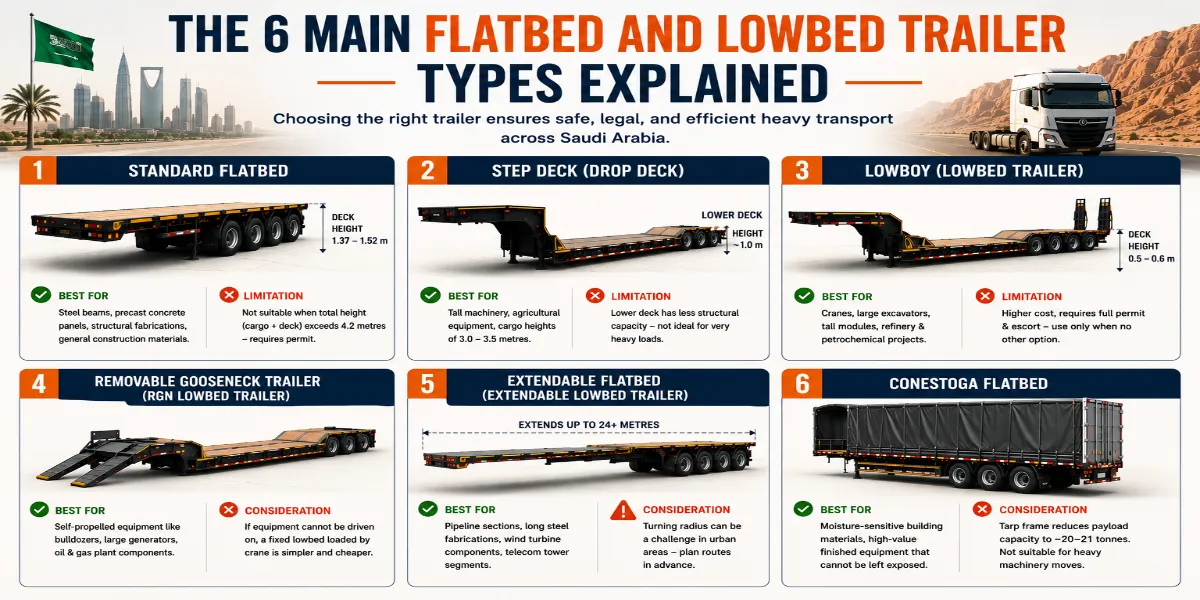
This is the workhorse flat deck, no sides, deck height around 1.37 to 1.52 metres off the ground. It handles steel beams, precast concrete panels, structural fabrications, and general construction materials that sit comfortably under the height ceiling. Where it falls apart is exactly where you’d expect: the moment cargo height plus deck height pushes past 4.2 metres total, a standard flatbed stops being a legal option and starts being a permit application.
Picture a flatbed with two levels, a raised section right behind the cab. Then a lower main deck further back, sitting at roughly 1.0 metre off the ground. That lower section is the whole point of the design. It buys back the height a standard flatbed’s deck eats up, making a step deck the natural choice for tall machinery, agricultural equipment, and anything in the 3.0 to 3.5 metre range that would otherwise need an over dimensional permit. The catch is structural: the lower deck is not rated as heavily as a standard flatbed’s deck, so it is not the answer when the cargo is genuinely heavy as well as tall.
Two deck drops instead of one, behind the cab, and again just ahead of the rear axles, bring deck height down to somewhere between 0.5 and 0.6 metres. That is about as low as a fixed-deck lowbed trailer gets in everyday use, and it is the default for cranes, large excavators, and the tall modules that show up on refinery and petrochemical projects.
Worth saying plainly: if a load can legally move on a step deck, putting it on a lowbed trailer instead is usually a waste of money. Lowbed moves cost more and almost always trigger the full permit and escort process, so they are for cargo that genuinely has no other option, not for cargo that is merely tallish.
This is a lowbed trailer with a front section, the gooseneck, that detaches and drops to ground level, forming a ramp. Deck height runs 0.46 to 0.6 metres, comparable to a fixed lowboy, but the ramp changes what is possible: self-propelled equipment can drive straight onto the deck instead of needing a crane. That makes RGN lowbed trailers the obvious choice for bulldozers, large generators, and oil and gas plant components, especially on sites where crane access simply is not there.
If the equipment cannot be driven or towed under its own power, though, a fixed lowbed trailer loaded by crane is the simpler and cheaper route. There is no reason to pay for ramp flexibility you are not going to use.
Take a standard flatbed and add a deck that stretches hydraulically or mechanically past the usual 14.6-metre ceiling sometimes out to 24 metres or more. Pipeline sections, long steel fabrications, wind turbine components, telecom tower segments anything where length, not height, is the binding constraint. When the cargo is both long and low-riding, this configuration is sometimes referred to as an extendable lowbed trailer in Saudi procurement.
What people tend to forget about extendable trailers is turning radius. A trailer that is perfectly legal on a highway can become a genuine problem on tighter urban roads in Riyadh or Jeddah, so route planning has to happen before the truck moves, not after it gets stuck at a roundabout.
A flatbed fitted with a rolling tarp system that slides over the deck on a frame, giving a full weather enclosure while still loading like an open deck. The tarp frame is not free, it trims effective payload down to roughly 20 to 21 tonnes, but for moisture-sensitive building materials or high-value finished equipment that genuinely cannot be left exposed, that tradeoff is worth it. It is not the right call for heavy machinery moves; you are paying a weight and cost penalty for weather protection that machinery generally does not need.
Most trailer selection errors come from comparing payload capacities and skipping deck height entirely. Saudi Arabia’s legal total height limit is 4.2 metres, that figure applies to cargo and trailer combined, not cargo alone. A load that appears to fit a standard flatbed on paper can trigger an overdimensional permit the moment it sits on the deck.
Trailer Type | Deck Height | Max Legal Cargo Height | Primary Assets |
Standard Flatbed | 1.37-1.52 m | 2.68-2.83 m | Steel beams, precast panels, structural fabrications |
Step Deck (Drop Deck) | ~1.0 m | ~3.2 m | Tall machinery, agricultural equipment, industrial units |
Lowboy (Lowbed Trailer) | 0.50-0.60 m | 3.603.74 m | Cranes, excavators, refinery modules |
RGN (Lowbed Trailer) | 0.46-0.60 m | 3.60-3.74 m | Self-propelled equipment, large generators, O&G plant components |
Extendable Flatbed / Lowbed | 0.46-1.52 m (varies) | Varies | Pipeline sections, wind turbine parts, telecom tower segments |
Conestoga Flatbed | 1.37-1.52 m | 2.68-2.83 m | Moisture-sensitive materials, high-value finished equipment |
If your cargo stands exactly 3.0 metres tall, here is how the total height calculation plays out across three trailer types, and what each result means for your permit status:
The step deck is the most cost-efficient legal option for this load. A lowbed trailer would also work, but the additional cost and permit process are not warranted unless the cargo dimensions demand it.
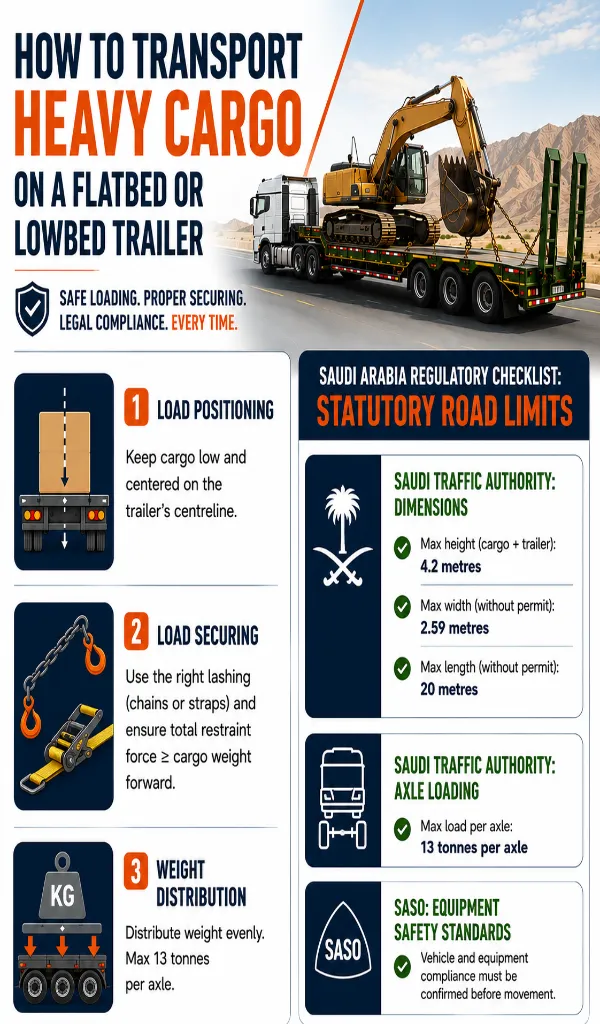
Three regulatory authorities govern flatbed and lowbed trailer movements on Saudi roads. Know all four statutory limits before a job is quoted, not after a truck is turned away at a checkpoint.
Saudi Traffic Authority: Road Clearance and Dimensions:
✓ Maximum total height (cargo + trailer): 4.2 metres
✓ The Maximum legal width (without permit): 2.59 metres
✓ Maximum legal length (without permit): 20 metres
Saudi Traffic Authority: Axle Loading:
✓ Maximum load per axle: 13 tonnes per axle
SASO: Equipment Safety Standards:
✓ Full vehicle and transport equipment compliance must be confirmed before movement begins not just before the cargo is loaded. This check runs independently of cargo securing compliance. Passing one does not satisfy the other.
Cross any of the Traffic Authority thresholds and an over dimensional load permit is required before the vehicle leaves the yard. That permit application needs a route plan attached, and movement is typically restricted to daylight hours. Night moves for oversized cargo are the exception, not the default. Loads above certain size thresholds also require a licensed escort vehicle.

WhatsApp us