Coordinating heavy haulage logistics across the Kingdom of Saudi Arabia requires a balance of high-capacity fleet mechanics and strict regulatory compliance. As Vision 2030 infrastructure expansions scale up across key industrial zones, the demand for specialized lowbed trailer transport continues to rise. Moving oversized assets, from high-tonnage refinery components in Jubail to fast-tracked construction machinery in NEOM, demands specialized planning. This guide reviews lowbed configurations, load securement criteria, and axle weight distribution rules necessary to keep your heavy transport operations compliant and on schedule.
Lowbed trailers (also called lowboy trailers) represent specialized heavy-duty transport solutions. They’re engineered specifically for moving oversized or heavy machinery and equipment. Load securement methods, axle and suspension basics, and transport safety principles all converge in these purpose-built trailers.
Key Design Features:
Ultra-Low Deck Height:
Gooseneck and Well Deck Configuration:
Ramp Systems:
| Trailer Type | Mechanical Configuration | Payload Capacity | Primary Industrial Focus | Targeted Saudi Use Cases |
| Standard Lowbed | Fixed gooseneck with well deck and adjustable rear ramps. | 25–50 Metric Tons | General construction equipment, industrial machinery, and manufacturing components. | Moving excavators, soil compactors, high-capacity site generators, and sub-station transformers. |
| Extendable Lowbed | Telescoping chassis design extending longitudinally up to 24 meters. | 50–80+ Metric Tons (Depends on axle count) | Structural cargo, elongated fabrications, and long-load infrastructure modules. | Cross-desert oil & gas pipeline transit, modular porta-cabins, and prefabricated bridge steel spans. |
| Hydraulic Lowbed | Integrated hydraulic lift systems for dynamic deck height and clearance adjustments. | 80–100+ Metric Tons (Maximum duty) | Super-heavy industrial components requiring precise alignment and low-clearance positioning. | Power plant turbine modules, high-tonnage factory machinery, and heavy oil rig components. |
| Removable Gooseneck (RGN) | Detachable front gooseneck segment creating a seamless, ground-level loading ramp. | 30–60 Metric Tons | Self-propelled heavy wheeled or tracked vehicles eliminating external crane dependencies. | Direct drive-on loading for heavy forklifts, large wheel loaders, and articulated site dump trucks. |
Ashwheelz maintains a comprehensive lowbed trailer fleet ranging from 25-ton standard units to 100-ton hydraulic systems. Align with extendable configurations up to 24 meters. We ensure precise matching to your cargo specifications and Saudi regulatory requirements.
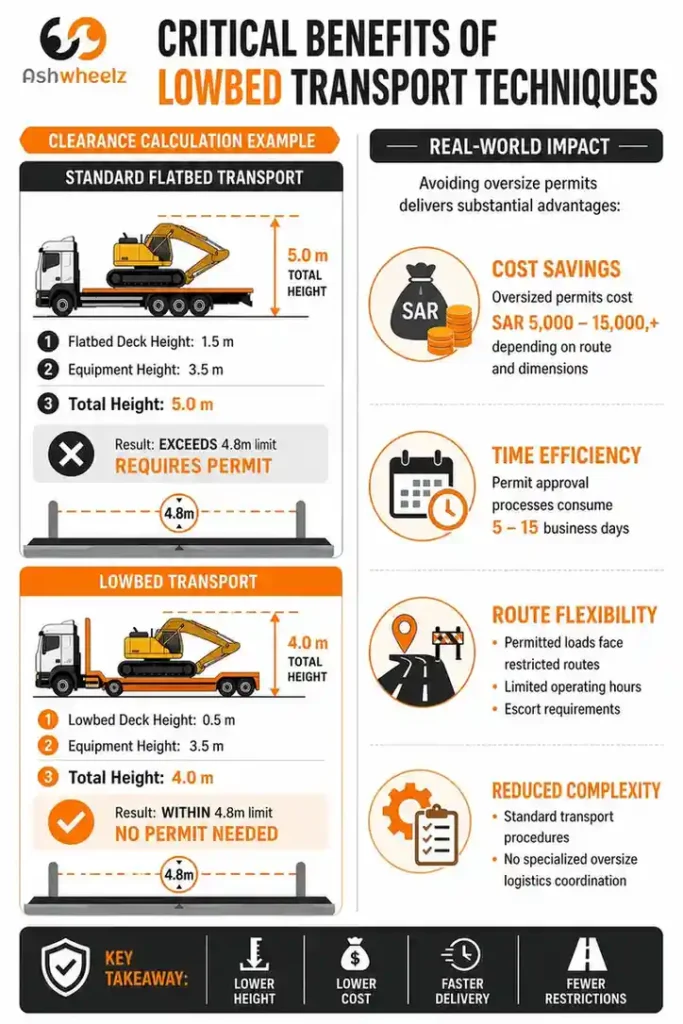
The primary benefit of lowbed trailers emerges from their ultra-low deck position. This is solving the fundamental challenge of moving tall equipment with its 4.8-meter total height restriction.
Clearance Calculation Example:
Result: EXCEEDS 4.8m limit – REQUIRES PERMIT
Result: WITHIN 4.8m limit – NO PERMIT NEEDED
Real-World Impact:
Avoiding oversize permits delivers substantial advantages:
Transport safety principles prioritize stability during movement. Weight balance concepts and operational transport risks decrease dramatically when the cargo’s center of gravity sits closer to ground level.
Stability Advantages:
Physics of Low Center of Gravity:
Saudi Arabia Terrain Considerations:
The Kingdom’s diverse transportation environment creates unique challenges:
Lowbed trailers’ inherent stability mitigates these environmental factors more effectively than standard trailers carrying equivalent loads at higher deck heights.
Industrial lowbed logistics streamline the loading/unloading process compared to standard trailer configurations. This reduces operational time and risk of equipment damage.
Loading Efficiency Benefits:
Direct Drive-On/Drive-Off:
Ramp Angle Optimization:
Ground-Level Access (RGN Trailers):
Ashwheelz provides comprehensive loading support, including certified operators experienced in equipment handling standards, safety protocols, and cargo distribution principles. This ensures efficient, damage-free loading operations.
Saudi Arabia’s petroleum industry represents the world’s largest and creates unprecedented demand for specialized lowbed equipment movement. Such as supporting drilling operations, processing facilities, and infrastructure expansion.
Critical Equipment Categories:
Drilling and Extraction Equipment:
Processing and Refining Machinery:
Route Planning Considerations:
Oil & gas operations frequently occur in remote Eastern Province locations:
Vision 2030’s ambitious infrastructure development; NEOM, Red Sea Project, Qiddiya, King Salman Park. This demands efficient construction logistics flow supporting massive equipment mobilization.
Construction Equipment Categories:
Earthmoving Machinery:
Material Handling and Lifting:
Specialized Construction Equipment:
Saudi Mega-Project Demands:
NEOM’s 26,500 km² development alone requires transporting thousands of equipment units:
Saudi Arabia’s industrial diversification under Vision 2030 drives manufacturing facility expansion, requiring precision machinery transport.
Industrial Equipment Transport:
Production Machinery:
Power Generation and Infrastructure:
Material Handling Systems:
Proper load securement methods represent non-negotiable requirements under Saudi Standards, Metrology and Quality Organization (SASO) technical regulations. Industrial transport safety demands multiple redundant securing systems preventing cargo movement.
Essential Securement Equipment:
Chains and Binders:
Wire Rope and Cable:
Ratchet Straps and Webbing:
Specialized Blocking and Cribbing:
Achieving proper weight balance concepts prevents dangerous situations during transport while ensuring compliance with Saudi axle weight regulations.
Longitudinal Load Distribution:
Proper Center of Gravity Positioning:
Calculating Load Position:
Example: 40-ton excavator on 3-axle lowbed
Excavator COG: 4 meters from the front
Trailer Length: 12 meters
Trailer Axle Center: 8 meters from the front
Analysis:
COG Position: 4m (forward of 6m midpoint) ✓ GOOD
Weight Distribution: ~65% front / 35% rear ✓ ACCEPTABLE
Tongue Weight: ~5 tons (12.5% of total) ✓ IDEAL RANGE
Lateral Load Distribution:
Side-to-Side Balance:
Ashwheelz certified operators conduct pre-transport inspections verifying load positioning, securement adequacy, and weight distribution compliance. Both with both Saudi regulations and international safety standards.
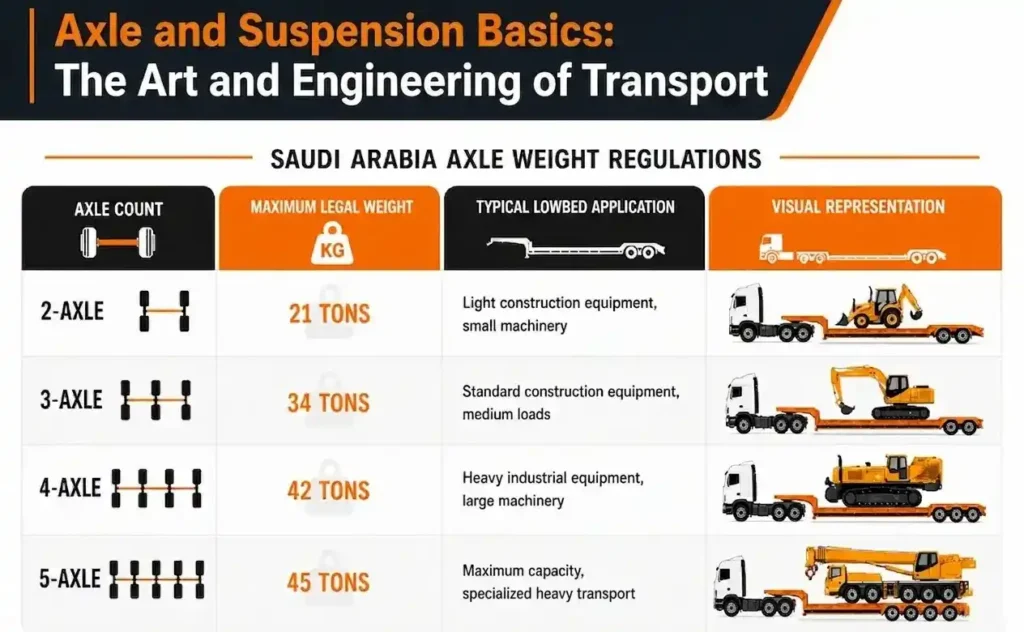
| Trailer Configuration | Max Weight Capacity & Penalties | Structural Cargo & Equipment Match | Fleet Operational Advantages | Recommended Suspension Profile | KSA Environmental Risks & Mitigation |
| 2-Axle Lowbed (Tandem Axle) | Up to 21 Metric Tons Gross. Penalty: SAR 200 per 100kg over limit (Max SAR 100k + impoundment). | Compact Utilities: 45-kVA Generators, 3-Ton Forklifts, Skid Steers, and light attachments. | Highly maneuverable in tight urban corridors; lowers operational maintenance costs for short-haul utility mobilization. | Mechanical (Spring): Robust leaf-spring setup. Built for high-mileage, basic transport with minimal maintenance complexity. | Risk: Summer heat (45°C+) causing rapid tire blowout. Mitigation: Pre-trip pressure validation and heat-rated tire compounds. |
| 3-Axle Standard (Tri-Axle) | Up to 34 Metric Tons Gross. Penalty: SAR 200 per 100kg over limit (Max SAR 100k + impoundment). | Mid-Range Earthmovers: Caterpillar D6 Dozers, Medium Excavators (PC200), and standard machinery. | Industry standard for multi-project logistics. Balances high payload capacity with wide geographic fleet availability. | Mechanical (Spring): Handles uneven ground and rough grit on desert pipeline roads without risk of airbag tears. | Risk: Sandstorms reducing visibility and infiltrating brake assemblies. Mitigation: Sealed brake drums and 24/7 technical field support. |
| 4-Axle Heavy Duty (Quad-Axle) | Up to 42 Metric Tons Gross. Penalty: SAR 200 per 100kg over limit (Max SAR 100k + impoundment). | High-Tonnage Processing: CAT 349 Excavators, Industrial Power Transformers, and large components. | Superior longitudinal weight distribution; essential for preserving road infrastructure and passing strict MOT checks. | Air Suspension: Heavy-duty pneumatic airbags. Provides critical self-leveling to keep top-heavy cargo stable. | Risk: High desert winds destabilizing high-profile or asymmetric machinery. Mitigation: Advanced Grade 70 chain tie-downs and custom steel chocks. |
| 5-Axle Multi-Tier (Specialized Quad+) | Up to 45 Metric Tons (Strict RGA Legal Limit). Penalty: Automatic project shutdowns and severe corporate fines. | Oversized Modules: Rig Mud Pumps, Heavy Drilling Skids, 100T Crane Booms, and refinery modules. | Maximum legal weight capacity; engineered specifically to prevent dangerous trailer sway during cross-province transit. | Air Suspension: Pneumatic airbags with adjustable ride height. Delivers premium vibration isolation for sensitive skids. | Risk: Driver fatigue on long cross-desert routes and flash flood risks in low valleys. Mitigation: Satellite GPS Journey Management (JMP) and dual operators. |
Comprehensive lowbed hauling guidelines ensure safe, compliant, efficient transport operations protecting both cargo and personnel.
Equipment Verification:
Cargo Assessment:
Load Securement Preparation:
Route and Permits:
Ashwheelz provides turnkey logistics support conducting all pre-transport assessments, regulatory compliance verification, and operational coordination, allowing clients to focus on core business activities.
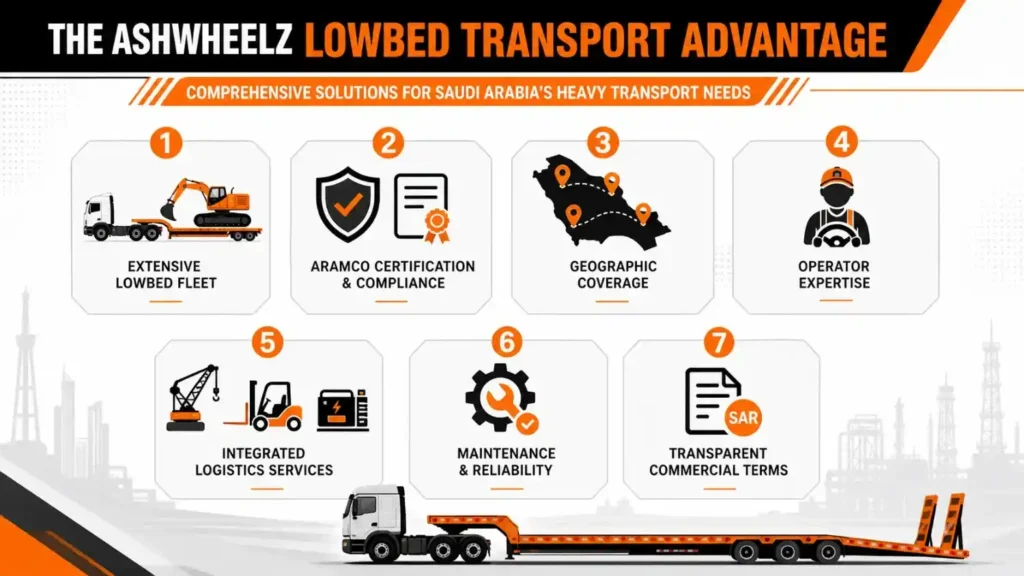
Ashwheelz is the Eastern Province’s premier lowbed provider, offering an extensive, SASO-certified fleet for heavy industrial applications. Our inventory ranges from 25-ton standard units and 50-80 ton extendable trailers (up to 24 meters) to 100+ ton hydraulic systems and Removable Gooseneck (RGN) configurations for seamless ground-level loading.
Engineered for highly secure zones, our fleet and operators carry full Saudi Aramco certification, ensuring instant access to regional oil and gas fields. Strategically stationed near King Abdulaziz Port and Jubail Industrial City, we provide rapid deployment across Dammam, Khobar, and Dhahran, with extended logistics support to Riyadh, Jeddah, and wider GCC corridors.
Every transport project is optimized for safety and uptime. Deployed drivers use satellite-tracked Journey Management Planning (JMP) to minimize transit risks, while our in-house workshops apply desert-adapted maintenance protocols to guarantee 99%+ fleet reliability, backed by a 24/7 emergency field support line.
We streamline B2B procurement by offering a single-vendor contract for turnkey industrial logistics. Our lowbed fleets scale with complementary 25–250T crane services, 3–16T forklift rentals, and portable power solutions under transparent, all-inclusive pricing. We offer flexible daily, monthly, or long-term contract structures to match changing project timelines.
Related Read: Equipment Rental vs. Transport Strategy: Maximizing ROI with the Right Lowbed Logistics
When evaluating lowbed trailer operations for your heavy transport needs, remember that proper equipment selection represents strategic investment in operational reliability, cargo protection, regulatory compliance, and schedule adherence, not mere transportation expense.
In Saudi Arabia’s rapidly evolving industrial landscape where Vision 2030 mega-projects demand flawless execution and equipment movement delays cascade into six-figure penalties, businesses recognizing transport’s strategic importance position themselves for sustained competitive advantage.
Every damaged load destroys profits and every delay triggers penalties. Because every safety incident damages reputation.
The solution? Partner with Saudi Arabia’s most trusted lowbed transport provider, a company combining comprehensive trailer inventory, regulatory expertise, proven safety records, and unwavering commitment to client success.
Ashwheelz stands ready to transform your heavy transport challenges into competitive advantages.
Don’t let suboptimal transport decisions compromise your project success. Contact Ashwheelz today or request a FREE lowbed trailer Quote and experience the difference that proper lowbed operations, expert planning, and professional execution deliver.
Your equipment deserves safe transport and schedule demands reliability. Also your budget requires transparency.
Ashwheelz delivers all three, every time, without exception.
The standard legal height limit across all highways managed by the Saudi Roads General Authority (RGA) is 4.8 meters from the road surface to the highest point of the load. Because standard flatbeds sit over 1.5 meters high, using an ultra-lowbed with a deck height of 0.5 meters (20 inches) is essential to transport tall equipment like excavators or porta-cabins without requiring special MOT highway permits.
To maintain cross-kingdom transit stability, cargo must be positioned so that roughly 60% of the gross weight sits on the front half of the trailer well deck. Proper longitudinal placement ensures adequate weight distribution on the truck's fifth-wheel coupling (tongue weight), preventing dangerous trailer sway and ensuring rear axle weight limits stay within legal limits.
An RGN (or lowboy) trailer is required when loading self-propelled wheeled or tracked machinery that cannot easily navigate the steep incline of traditional rear ramps. By detaching the front gooseneck, the trailer deck drops completely flat to ground level, allowing low-clearance assets like heavy forklifts, asphalt pavers, and wheel loaders to drive directly onto the well deck.
Heavy machinery must be anchored using industrial Grade 70 transport chains equipped with matching ratchet-style load binders. For high-weight assets, a minimum of four separate tie-down points must be anchored directly to the lowbed's heavy-duty D-rings, with additional intermediate binders integrated for every extra 5,000 lbs of cargo weight.
Yes. While standard mechanical leaf-spring suspensions are used for heavy earthmovers on rugged construction sites, highly sensitive oilfield cargo—such as delicate control skids, calibrated transformers, or pipeline instruments, requires air suspension systems to dampen over-the-road vibration and prevent structural damage during remote desert transit.

WhatsApp us