
Talk to any procurement manager on an Aramco-linked project in the Eastern Province. The conversation about heavy equipment almost always ends in the same place. How do you get the right machine on-site without tying your budget in a knot for the next five years? That question is sharper than ever in 2026. Giga-projects are stacking up faster than most contractors anticipated. The old assumption that owning your fleet is always the safer bet no longer holds.
This guide is written for the people making the actual call: procurement leads, site engineers, and finance teams. We work through the financial structure, the Aramco compliance picture, the equipment ecosystem, and the operational realities that determine which acquisition model fits your project type.
Request a Strategic Fleet Consultation Today, Project scope, site location, timeline. We build the rental plan around your requirements.
Something shifted noticeably over the last few years. Major EPC contractors and subcontractors in Jubail and Dammam are rethinking equipment ownership. The default used to be simple: buy the crane, put it on the books, depreciate it, and it is always there when you need it. That logic made sense when project pipelines were predictable and compliance demands were lighter.
Three things changed. First, Saudi Vision 2030 compressed project timelines. Equipment idle periods became genuinely expensive. A crane sitting in a lay-down yard between project phases is not a dormant asset it is accruing storage costs, security costs, inspection costs, and certification renewal deadlines. Second, Aramco and the Royal Commission tightened their compliance requirements. Keeping owned machinery current demands a maintenance and certification infrastructure most project-focused contractors never built. Third, rental providers got serious about fleet quality. Renting Aramco-compliant, TPI-inspected cranes on short notice from Al Khobar simply did not exist at scale a decade ago.
In 2026 specifically, buying new heavy machinery carries an additional risk. Global supply chain backlogs mean lead times for new equipment purchases stretch six to eighteen months. For contractors on fast-tracked contracts, that wait is not acceptable. Immediate rental is the only practical route when mobilization windows are measured in weeks, not quarters.
The result is what the industry now calls an asset-light model. Contractors convert fixed fleet ownership into variable project costs. Equipment is rented against confirmed permit issuance, used for the project phase, and returned. The finance team gets cleaner books. The site manager gets certified equipment without the compliance headache. The company does not spend five years depreciating machinery that works six months a year.
Most TCO conversations start and stop at the purchase price. A 300-ton all-terrain mobile crane runs SAR 4 to 6 million new. A 5-ton diesel forklift sits in the SAR 90,000–130,000 range. Those numbers go into the capital expenditure request. What often does not make it into that document are the costs that run continuously after the purchase order closes.
Secure storage in Jubail Industrial City II or Dammam’s Third Industrial Area is not free. Lay-down areas for heavy crane configurations carry monthly lease costs. These compound quickly over inter-project gaps. TPI re-inspection cycles under Aramco’s maintenance requirements are mandatory on fixed intervals. They cannot be deferred. Operator TPI card renewals, SASP compliance updates, and TUV re-certification each carry their own cost and scheduling demands. And 24/7 security for high-value mobile cranes parked at a local yard adds another recurring line item.
None of that appears in the original capital expenditure calculation. When you add it back in, the three-year cost picture looks considerably different than the purchase invoice suggests.
Purchased heavy equipment depreciates over 7 to 10 years under standard KSA accounting treatment. That depreciation creates a tax deduction. But it spreads across years and does not help cash flow in the period the equipment was most heavily used. Rental payments work differently. They are fully deductible as operating expenses in the period paid. For contractors with revenue tied to project cycles, that timing difference matters more than most capital expenditure approvals acknowledge.
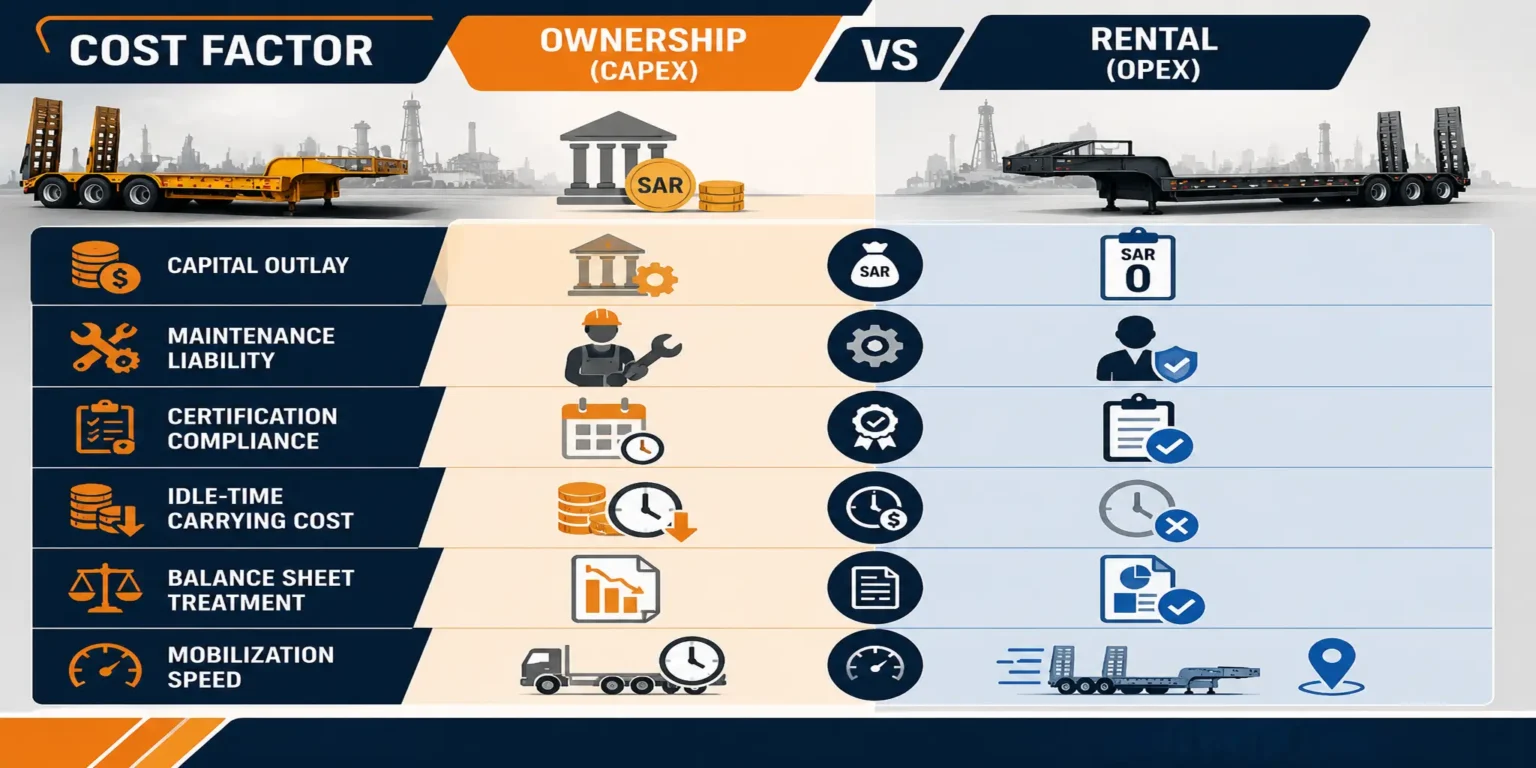
Cost Factor | Ownership (CAPEX) | Rental (OPEX) |
Capital outlay | SAR millions locked at purchase | Zero upfront, billed per use period |
Maintenance liability | Carried entirely by the company | Absorbed by the rental provider |
Certification compliance | Internal scheduling and cost | Managed within the rental agreement |
Idle-time carrying cost | Continues regardless of utilization | Stops the moment the rental ends |
Balance sheet treatment | Depreciating fixed asset | Off-balance sheet under IFRS |
Mobilization speed | Subject to transport and permit lead times | Pre-staged, same-day in Jubail and Dammam |
Contractors new to Aramco-affiliated work sometimes treat equipment compliance as an administrative layer – something you sort out in the weeks before mobilization. Site engineers who have been through a permit rejection know it works the other way. On an Aramco or Royal Commission project, a single gap in equipment certification does not just delay that lift. It triggers a permit review that can idle your entire scope while the paperwork gets resolved.
Aramco General Instruction GI 7.027 governs all lifting operations on affiliated sites. Compliance means the crane has been inspected and tested against that standard: load charts verified, wire rope condition documented, boom configuration checked, safety interlocks confirmed functional, and the operator’s qualification card matched to the equipment class. Every one of those boxes has to be checked before a lift permit is issued. Renting from a provider who maintains that documentation as part of their fleet management takes that burden off your team entirely. Leading Leading crane rental companies in Saudi Arabia invest heavily in keeping this documentation current for their entire fleet – so their clients don’t have to.
Equipment certification covers the machine. Operator certification covers what happens when someone climbs into the cab. For crane operations specifically, the Rigger Level I, II, and III structure governs exactly what type of lift each operator is authorized to execute. Sending an operator with the wrong designation to a complex tandem lift on an Aramco site is not a minor procedural issue it is a permit violation with real contractual consequences.
When you use a rental provider’s TUV-certified operators, their certification file is their responsibility, not yours. That matters practically when your HR team is managing 200 workers across three sites and does not have bandwidth to track TPI card expiry dates for every equipment operator in the pool.
International EPC firms entering the Saudi market via the Ministry of Investment face additional equipment operation licensing requirements. Building that compliance infrastructure from scratch takes time and local knowledge. A rental provider that already holds those approvals eliminates months of setup time directly relevant when your mobilization window is tight.
Verify Fleet Certification Readiness Aramco-certified fleet and TUV-licensed operators available for immediate mobilization in Jubail and Dammam.
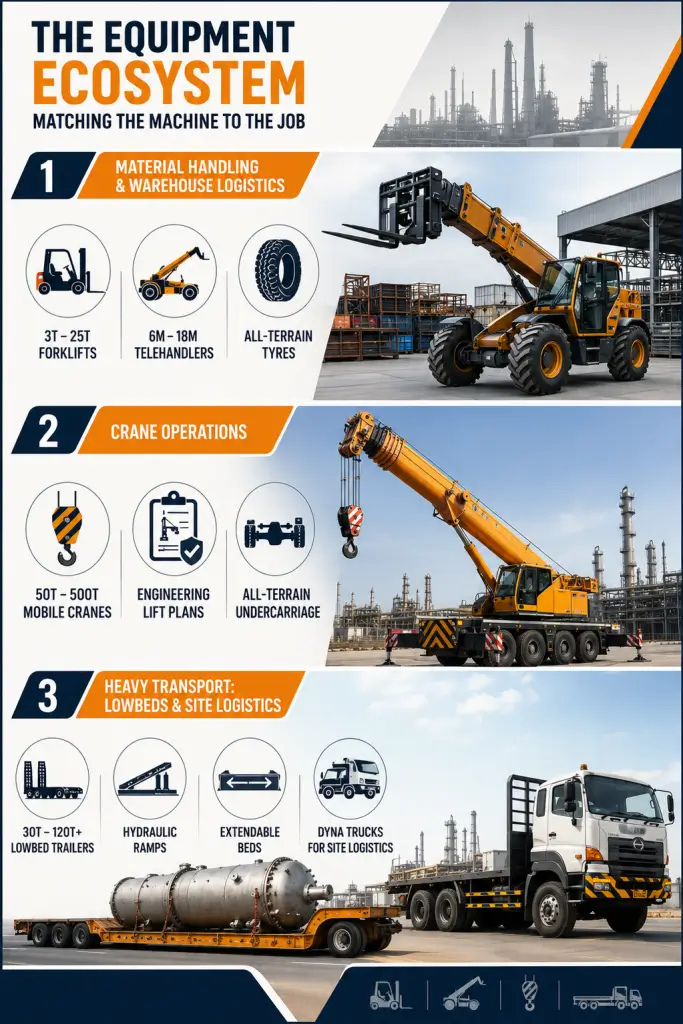
Not every job on a petrochemical site requires a crane. A significant portion of daily material movement component staging, container unstuffing, intra-site logistics is faster and cheaper with the right forklift or telehandler. Many contractors default to a crane call when a 7-ton telehandler would handle the job at a third of the daily rate.
Industrial telehandler rental fills the gap between a standard counterbalanced forklift and a full mobile crane mobilization. Boom reach from 6 to 18 meters, load ratings in the 3T to 10T range, and 4WD configurations suited to Jubail and Dammam construction zones.
For heavy vertical lifts on Aramco or SABIC sites, the load chart is the starting point of every conversation. Boom length, counterweight configuration, ground bearing pressure at each outrigger pad, radius, and the weight of the lifting gear all feed into the approved lift plan before a permit is issued. Selecting the right crane should come from an engineering review of lift parameters, not from availability or habit.
Reputable crane rental companies in Saudi Arabia provide engineering-reviewed lift plans for every complex operation. This is the baseline standard on Aramco and Royal Commission sites not an optional add-on.
Getting an oversized component from King Abdulaziz Port in Dammam to a refinery site in Jubail is not a standard haulage job. Reactor vessels, transformers, and fabricated structural modules that exceed standard load limits require specialist transport solutions.
For oversized cargo, lowbed trailer configurations in the 30T to 120T+ range are the standard solution. Hydraulic folding ramp setups allow self-loading capability. Extendable beds handle variable cargo lengths. Choosing the right lowbed trailer rental KSA provider means confirming they carry the correct configurations not just the largest trailer in their yard.
Within industrial city limits, Dyna truck rental covers smaller-scale logistics that full trailers cannot manage efficiently: tight turning radii, weight restrictions on internal roads, and short-haul runs between lay-down areas and active work fronts.
Just-in-Time fleet deployment is the difference between a crane on-site within hours of permit approval versus a crane that shows up two days after your window opened. Pre-staged fleet inventory in Jubail and Dammam means mobilization happens against confirmed permit issuance, not transport scheduling from a distant yard.
On sites running multiple parallel work scopes, equipment arriving early creates congestion and standby costs. Equipment arriving late pushes critical-path activities. Pre-staged inventory from a local hub is the most practical tool for hitting your mobilization window.
Jubail Industrial City and Dammam’s industrial areas operate under distinct entry permit regimes. Jubail’s Royal Commission has its own equipment inspection and gate credentialing process. MODON governs the Dammam industrial areas under a separate framework. Operators need site-specific credentials on top of their standard TPI certification. The equipment itself must pass each site’s entry inspection.
A rental provider that has been running equipment into these sites for years already has the relationships, documentation formats, and pre-clearance processes that reduce your mobilization timeline. That is practical value, not marketing language.
In-Vehicle Monitoring Systems are not optional on most Aramco-compliant fleet deployments anymore. Real-time GPS positioning, speed threshold monitoring, and driver behavior analytics are written into the security protocols of multiple energy sector clients across the Kingdom. If your project site requires IVMS-equipped vehicles and your rental provider does not run them, you have a compliance gap before the first shift starts.
Every rental agreement promises 24/7 maintenance support. The question is where the technician is based when the call comes in at 2 am during a night shift. A provider with maintenance staff staged in Dammam and Jubail can respond within the same shift. A provider whose nearest technician is in Riyadh cannot regardless of what the contract says about response time commitments.
Daily hire rates typically run 20 to 35 percent higher per day than equivalent monthly rates. For a defined short-scope work package – a single structural lift campaign, a two-week shutdown period – that premium is the cost of flexibility. You are not committing to a machine for longer than the job lasts. For sustained project phases running three months or more, a locked monthly rate delivers budget certainty that daily hire cannot.
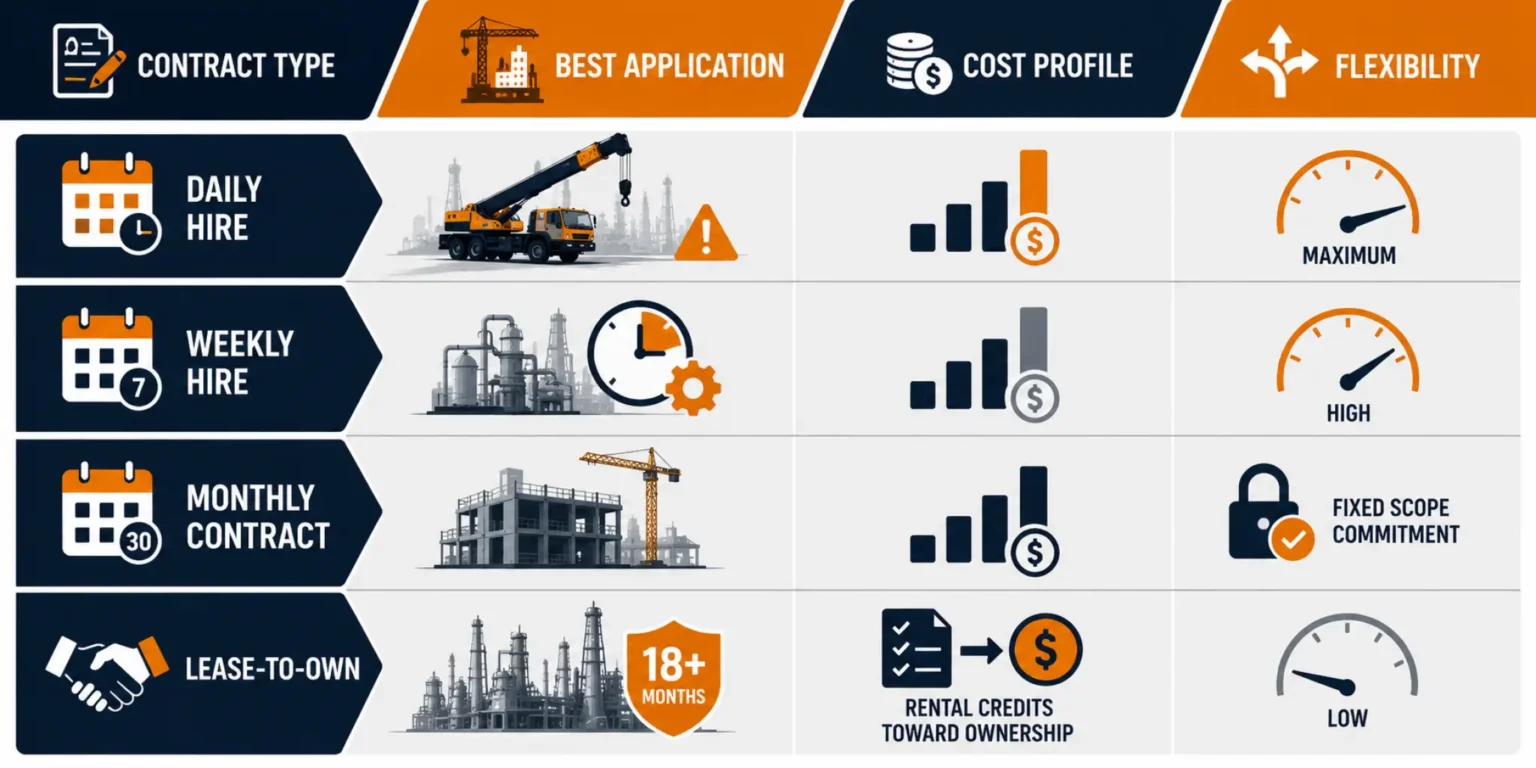
Contract Type | Best Application | Cost Profile | Flexibility |
Daily Hire | Emergency lifts, single-event scopes | Highest per-day rate | Maximum |
Weekly Hire | Shutdown support, short maintenance windows | Moderate premium over monthly | High |
Monthly Contract | Sustained project phases | Best per-day rate | Fixed scope commitment |
Lease-to-Own | Long-duration projects (18+ months) | Rental credits toward ownership | Low |
Rental agreements for heavy equipment in Saudi Arabia vary considerably in how they handle costs. Before signing, confirm in writing:
Ambiguity on any of those points does not surface during smooth project execution. It surfaces when something goes wrong – which is exactly when you need the contract language to be unambiguous.
Contractors with multi-year project pipelines in a single equipment class sometimes find that rental economics eventually tip toward ownership. Lease-to-own structures let a portion of rental payments credit toward a purchase price, turning an OPEX stream into a path to eventual CAPEX. This works when two conditions are met: confirmed long-term utilization that justifies ownership carrying costs, and an internal maintenance infrastructure capable of managing certification compliance without outsourcing it to the rental provider.
Our operations run out of Al Khobar, which puts us inside the two-hour mobilization window for Jubail Industrial City I and II, Dammam’s First, Second, and Third Industrial Areas, King Abdulaziz Port, and the surrounding Eastern Province project zones. That geography is deliberate it is where the project density is, and it is where pre-staging fleet inventory actually makes a difference.
Two decades of running equipment on Saudi project sites Aramco shutdowns, SABIC refinery expansions, remote oilfield mobilizations sits behind those numbers. The maintenance protocols, operator qualification records, and permit facilitation processes that institutional knowledge does not show up in a spec sheet. But it shows up in how fast your equipment arrives and how reliably it stays running.
Request a Strategic Fleet Consultation Today, Tell us the project scope, site, and timeline. We build the plan from there.
The rental versus purchasing question does not have a single right answer. But it does have a clear direction for most project-driven contractors. If your utilization is project-based, your sites span multiple locations, and you do not have an in-house maintenance and certification infrastructure, the OPEX rental model is almost certainly the more cost-effective approach.
Vision 2030 is producing project demand faster than most contractors can build owned fleet capacity to match it. Trying to keep pace through capital expenditure on equipment that will sit idle between project phases is a losing financial strategy. Partnering with AshWheelz gives you the certified fleet, the compliance documentation, and the local Eastern Province presence to stay agile in a market that is moving fast.
Get Your Mobilization Plan, AshWheelz. Crane, forklift, and transport rental in Jubail, Dammam, Khobar, and Riyadh. Contact us today.
Answer: For projects extending beyond 18 months with stable, predictable equipment utilization, the financial balance typically tips toward ownership or a Lease-to-Own structure. However, this is only viable if you possess an established internal maintenance team capable of managing ongoing Aramco and TUV re-certification timelines without relying on third-party agencies.
Answer: A single certification gap can instantly halt your entire site permit. Reputable rental providers absorb this operational liability completely. They manage, update, and supply pre-vetted crane documentation, load charts, safety interlock validations, and valid TUV operator qualification cards directly with the fleet asset so your crew is gate-ready on arrival.
Answer: Beyond the initial capital outlay (CAPEX), ownership demands continuous operational spending (OPEX). This includes high monthly lay-down fees in secure zones like Jubail Industrial City II or Dammam's Third Industrial Area, mandatory periodic TPI inspections, ongoing security setup costs, and regular operator card renewals—even when the asset sits completely idle between project contracts.
Answer: Due to persistent global supply chain backlogs, factory lead times for ordering and importing new specialized transport machinery (like heavy-duty cranes or lowbed setups) currently range between 6 to 18 months. Opting for a localized rental solution allows you to bypass these manufacturing delays with immediate, same-day fleet mobilization.
Answer: Daily hire rates offer maximum operational flexibility for short-term support windows (such as refinery shutdowns or single-lift campaigns), but they carry a 20% to 35% premium per day. For long-duration project phases running 90 days or longer, locking in a monthly contract provides necessary budget predictability and significantly lowers your net daily operating costs.

WhatsApp us